
How your company runs, in one source of truth
Visual process models and database-backed RACI in one place. Knowledge in people's heads becomes an institutional system.
Word and Visio
RACI
| Record the request | R | A | I | · |
|---|---|---|---|---|
| Line manager approval | I | R | · | C |
| Select the supplier | · | I | R | C |
Process
P-04 value chain · L3 detail · v2.4
The standard behind every process map
L3
Detail level of every process map
16:9
One process, one screen
RACI
Accountability on every step
The operation lives in people's heads, not in a system
It is not a lack of intent. Most companies do have documentation, policies and process descriptions. Just not where, how, and for whom the actual work happens.
The one-person bottleneck
When that one colleague takes leave or resigns, work stops. A critical part of the operation exists only in their head, undocumented. Their successor spends months reverse-engineering the same knowledge.
Onboarding by Chinese whispers
New joiners shadow a senior colleague for weeks and hear something different from everyone. Training happens by word of mouth, so accuracy degrades with every retelling.
A process does not come alive because it is written down. It comes alive when the person who has to act on it can find it.
OnlyProcess methodology
Sound familiar?
- There is a process only one person can complete end to end.
- Onboarding takes as long as whoever happens to have time.
- One simple question gets you three different answers.
- Audit documentation is written separately from what we actually use.
Isolated silos, forgotten files
Hundred-page Word and Visio policies gather dust in a drawer. Nobody reads them, nobody keeps them current, yet they are what we point to during an audit.
Everything escalates upward
With unclear accountability every decision stalls at senior management. Leaders spend their day on operational detail while strategy waits.
Order the organisation actually uses
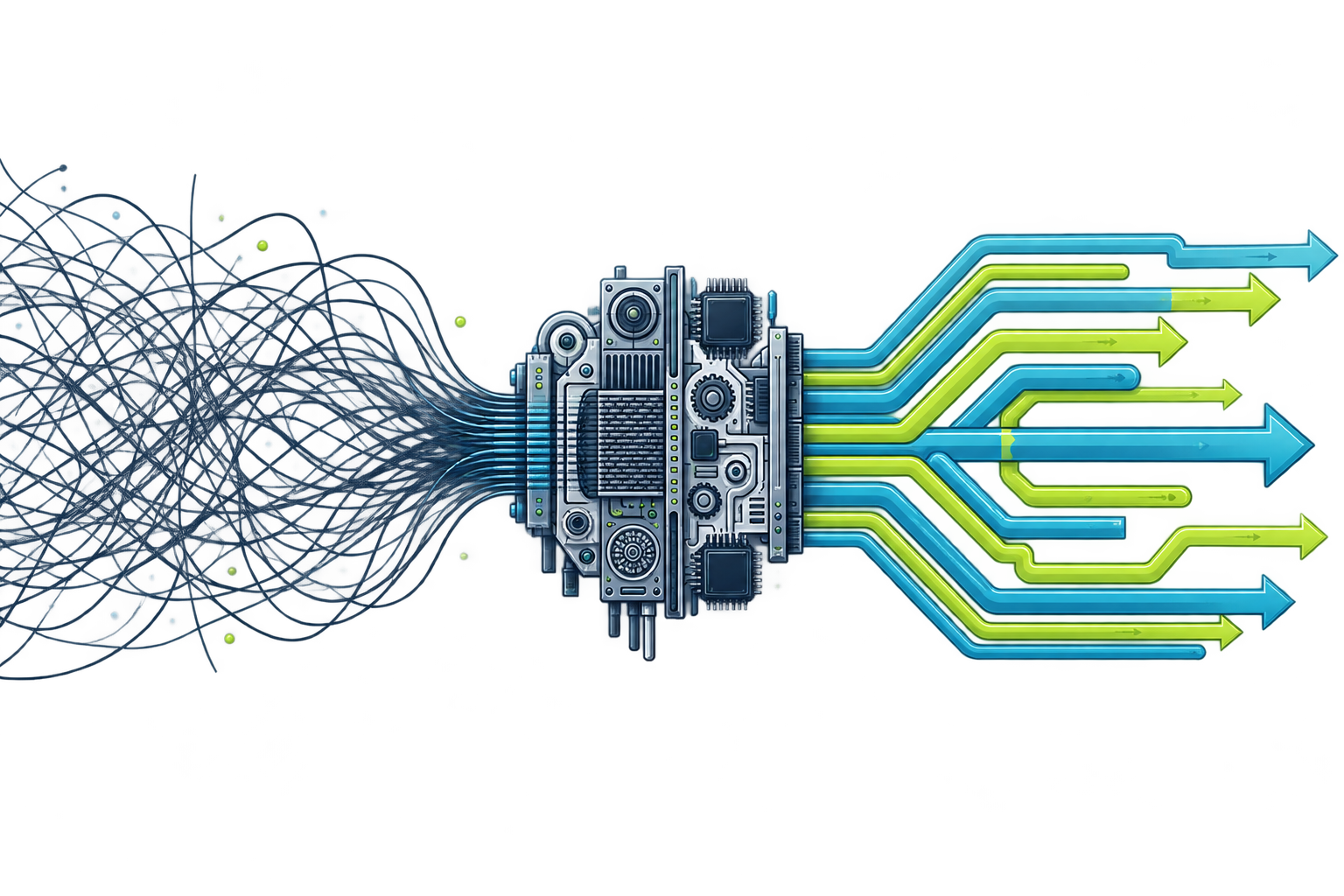
OnlyProcess is not another document repository. It is a database where the step, the accountability and the metric belong together, and where everyone gets the view they actually need.
Policy document from 2019
4.2.1 The requester shall record the purchase request…
4.2.2 Approval follows the applicable and effective…
4.2.3 Where budget is not available, the requester…
…and 96 more pages
Drag the slider
Two lenses: authors and consumers
The specialist modelling a process needs an editor. The colleague doing the daily work needs guidance. Same data, two purpose-built views, so nobody fights an interface designed for someone else.
The 16:9 rule
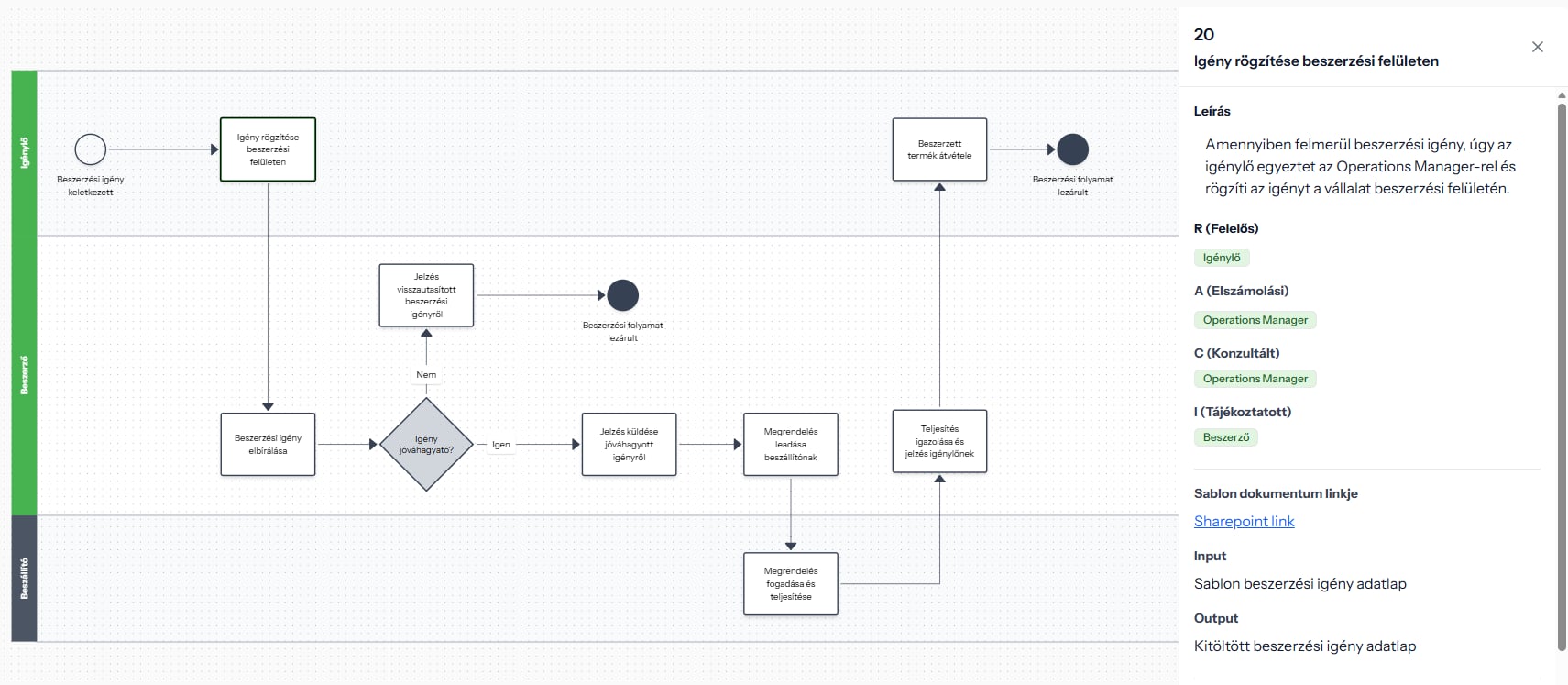
One process on one screen, read left to right. Not BPMN 2.0 with a training course attached, but a model simple enough that a new joiner understands it at first glance.
Database-backed RACI
Responsible, accountable, consulted and informed do not live in a separate spreadsheet. They belong to the step, so a reorganisation means editing one record, not forty files.
Permissions that mirror the org
A reader licence for everyone, a process editor licence for those who may publish. If you do not edit, you cannot accidentally break anything either.
Process and accountability, one click apart
Same data, two views. The process map shows what happens and in what order. The RACI matrix shows who owns what. Switching between them never loses your context.
A left-to-right process with a decision gateway and a feedback loop.
Responsible, accountable, consulted and informed on every step.
Inputs, outputs, lead time and KPIs on the step record itself.
We do not hand over software, we hand over order
The software sustains the order, but first we also have to create it. If you have no experience in process mapping, we recommend our Project package. A consulting project with tangible deliverables.
- 01
1–2 weeks
Process catalogue and value chain
We map the full value chain of the company or team, and decide together what goes into scope and what we assess in more depth. That produces the process catalogue: an ordered list of the company's processes. Without it, modelling never converges.
Value chain mapProcess catalogueScope list - 02
4–8 weeks
Structured interviews with the experts
Focused interviews with the people who actually do the work (SMEs). Not a multi-day workshop marathon: one process, one expert, one focus. We then validate the result by cross-checking with the adjacent roles. With biweekly status updates.
Interview planCaptured process stepsCross-check - 03
1–2 weeks
Modelling, release, handover
The captured processes go into OnlyProcess at L3 detail, with RACI matrices and input/output lists. The methodology is handed over too, so you can already assess the next processes on your own.
L3 process mapsRACI matricesMethodology handover
What you hold at the end of the project
L3 process maps
Inside OnlyProcess, in a live system, not as static images. What changes tomorrow can be edited tomorrow.
Customisable RACI matrices
With input and output lists, and any further custom data on every process step, bound to roles. A reorganisation means rewiring assignments, not rewriting documents — available to every colleague immediately.
A bound, physical process book
A printed volume with the first processes you assessed. Years later it is good to look back and see how far the company has come.
Predictable pricing, without the enterprise games
Two licence types and one up-front assessment project. No haggling per module and no hidden implementation band.
Reader licence
A knowledge base available to every employee: read processes, search, view RACI.
- Unlimited process viewing
- Process and RACI views
- Search by step and by role
- Input/output and KPI data
- Readable on mobile
Process editor licence
Edit, modify and publish processes. Keeping process control in one place.
- Create and edit processes
- Manage RACI and role model
- Versioning and publishing
- Process catalogue administration
- Everything in the reader licence
Process model offer
A 3-month project focused on your most important processes.
A one-off project fee to assess your first 10 in-scope processes and hand over the methodology.
- Value chain and process catalogue capture
- 10 processes assessed at L3 detail
- Structured SME interviews with cross-checking
- RACI matrices with input/output lists
- A bound, physical process book
- Methodology handover to your team
- Includes two process editor and twenty reader licences for the first year
What is worth knowing about process assessment
Articles on the pain points leaders actually feel and on assessment methodology. Not product marketing, but usable experience.
Frequently asked questions
If your question is not here, ask it in a 30-minute call.
Assessing and modelling the first 10 processes typically takes 4–8 weeks, depending on company size and how easily interviews can be scheduled. The process catalogue is visible after the first one or two weeks, so results do not arrive only at the very end.
No, the software works on its own. Experience says an empty system tends to stay empty though: the assessment is what provides content and methodological routine. That is why we recommend it first, and why we hand over the methodology so you can continue independently.
Because the primary audience is not the process manager but their colleague who has to act on the description tomorrow morning. In our experience BPMN is precise and complete, but the average employee finds it hard to read. We follow the 16:9 rule instead: one process on one screen, left to right, clearly understandable without explanation.
RACI is database-backed, so the role and the step are separate records. A reorganisation means changing the assignment attached to a role, not rewriting forty documents. The process map stays as it is, only the owners change.
From a browser, on a reader licence at HUF 1,000 per employee per month. Editing rights sit only with process editors, so the knowledge base cannot quietly fall apart. The permission model is deliberately this simple.
Yes. Processes are versioned, accountabilities are traceable, and at the end of the project we also hand over a bound, physical process book. The auditor works from the same source as your colleagues, not from a document written specially for them.